This is part one in a series about living put the “way.” Early Christians were consistently referred to as followers of the Way. This refers directly to Jesus, the Christ, and the manor of life that He both demonstrated through His life and directs to this day.
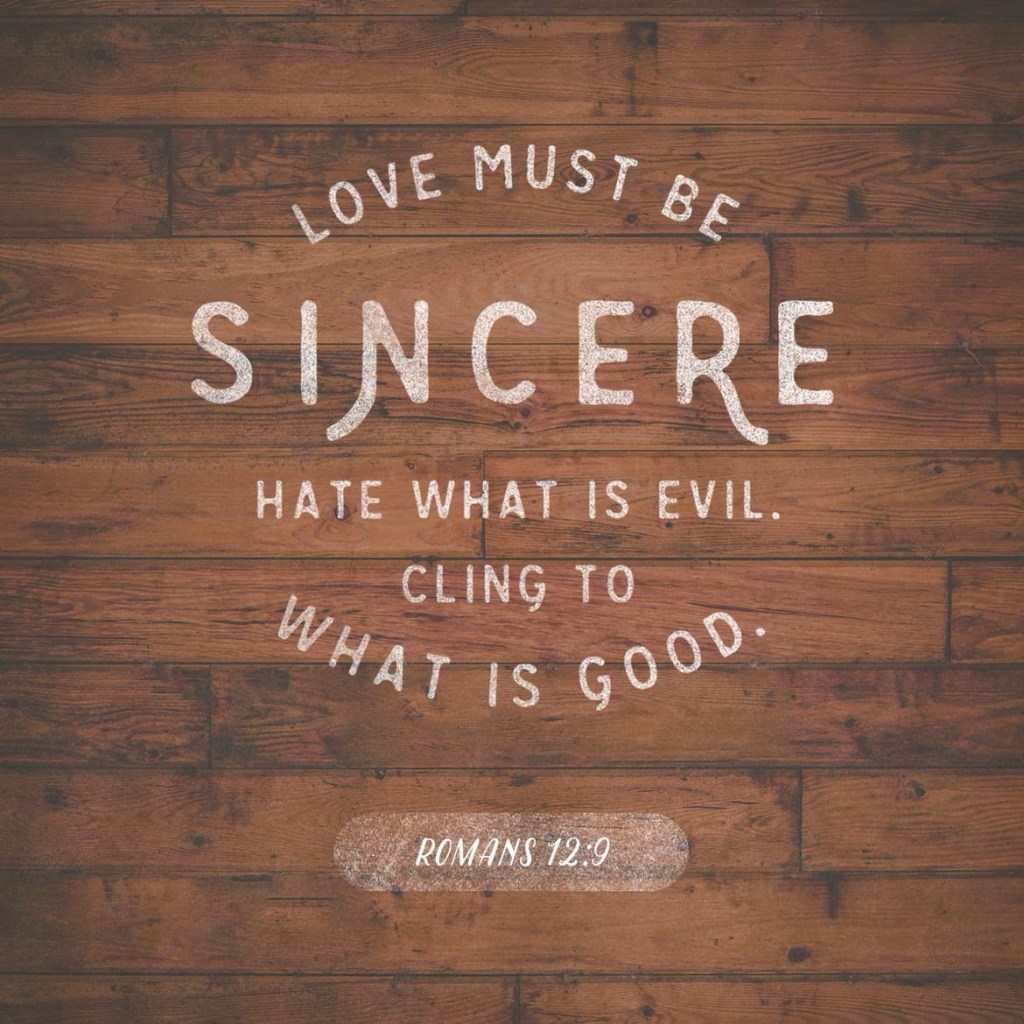
Love must be sincere. Hate what is evil; cling to what is good.
Romans 12:9
In just a few words, Romans 12:9 delivers a powerful challenge: love with sincerity, reject evil, and hold tightly to the good. It’s simple, yet deeply transformative if we truly live it out.
What Does It Mean to Love Sincerely?
To love sincerely means to care for others without pretending. It’s not about fake smiles or saying the right things while harboring resentment. Paul is calling us to a love that comes from the heart—a love that mirrors Christ’s own. It’s a love that shows up in kindness, honesty, forgiveness, and action.
Sincere love doesn’t pick favorites. It’s not based on what we can get from others. It’s a choice to value people because they are made in God’s image.
Hate What Is Evil
Love and goodness go hand-in-hand. That’s why Paul also says to hate what is evil. We’re not called to hate people, but we should hate the things that harm others—like injustice, lies, cruelty, and selfishness. Sincere love isn’t passive. It stands up for what’s right, even when it’s uncomfortable.
Cling to What Is Good
The word “cling” in Greek means to stick like glue. When the world feels messy or confusing, Paul urges us to hold fast to what is good—truth, mercy, patience, and grace. These are not just nice ideas; they are powerful tools in loving others the way Jesus loves us.
Think about your relationships—family, coworkers, church, neighbors. Are you loving sincerely, or just going through the motions? Do you speak truth in love, or avoid hard conversations to keep the peace? Are you clinging to good, even when it’s hard?
This verse calls us back to the heart of the Christian life: genuine love. It’s not always easy, but it’s always worth it.
Peace, purity, and sincerity in Christ brothers and sisters.
Have I not commanded you? Be strong and courageous. Do not be afraid; do not be discouraged, for the Lord your God will be with you wherever you go.
Joshua 1:9
Our faith should create in us a courage, a strength that is unwavering in the face of so many of life’s trials. As C.S. Lewis once said, “Courage is not simply one of the virtues, but the form of every virtue at the testing point.” I would like to look at three stories from the Bible that exemplify a courageous faith.
#1 Jehoiada (ye ho yaw da) and Jehosheba (ye ho shaw ba)- the princess and the priest who saved a king (2 Kings 11:4-17) (also 2 Chron 22-24)
Jehosheba as a member of the royal family, saw the evil plot unfolding and acted to save Joash (yo rash). Jehoiada was a high priest during that dark time in Judah’s history, when Queen Athaliah, obviously an ruthless woman from the line of Ahab, had seized the throne and murdered the royal family to secure her power.
Both Jehoiada and Jehosheba, acting with bold faith and wisdom, hid Joash, the rightful heir to the throne, in the temple for six years, protecting him from Athaliah’s murderous purge.
In the seventh year, Jehoiada revealed Joash to the captains of the guard and hatched a strategic coup. He divided up the divisions and combined both group going iff duty for the sabbath and the group coming on duty for the sabbath to guard the future king and surround the house of the Lord. And things couldn’t have worked out better. The queen tried to stop the anointing from happening but it eventually costs her life.
The plan played out beautifully. But going to the captains of the guard could have gone very differently. This plan could have backfired at the cost of everyone’s lives who were involved in the plot. But God honored the faith and courage of Jehosheba and Jehoiada.
Joash did what was right in the eyes of the Lord all the days of Jehoiada…
2 Chronicles 24:2
Corrie ten Boom is quoted as saying, “Never be afraid to trust an unknown future to a known God.” Jehosheba’s and Jehoiada’s courage was not loud or flashy, it was steadfast, wise, and grounded in God’s promises. They show us what it’s like to trust God especially when everything looks dim and uncertain. Their lives remind us that spiritual courage often means standing firm when no one else will, protecting the vulnerable, and restoring truth in times of darkness.
#2 Shiprah (shi frah) and Puah – midwives who defied the Pharaoh (Exodus 1:15-21)
They defied the Most Powerful Man on Earth. Pharaoh’s command was clear, but Shiphrah and Puah feared God more than Pharaoh. They refused to murder the Hebrew boys, risking their lives.
In addition to that, they stood up without weapons or position. These were ordinary women with no political power or military force. Their only strength was moral conviction and reverence for God.
Charles Spurgeon said, “The Christian should be bold as a lion. That confidence is born not of self, but of God.” These women had confidence, not in who they were but in who God is. That can empower the lowliest of people and that is what the power of Christ is meant to do in each of our lives.
Because the midwives feared God, he gave them families of their own.
Exodus 1:21
Their reverence and courage were noticed and honored by God, who blessed them personally and used their defiance to help preserve Israel’s future leading to the birth of Moses, their deliverer.
#3 Baruch – the man who gave us Jeremiah (Jeremiah 36:4-32)
He Wrote God’s Words at Great Risk. In Jeremiah 36, Baruch wrote down the prophetic warnings from Jeremiah messages of judgment against Judah and read them publicly at the temple, knowing it could cost him his freedom or life.
Baruch goes on to reads the scroll in the presence of large crowds. One of the officials hears it and goes to tell the others. This group of officials invite Baruch to read it to them. Upon hearing the word, the officials tell Baruch and Jeremiah to hide while they take the words to the king. As the king hears the scroll he cuts pieces off and throws them into the fire. Then the king sought the two of them but God hid them.
Then Jeremiah took another scroll and gave it to Baruch the scribe, the son of Neriah, who wrote on it at the dictation of Jeremiah all the words of the scroll that Jehoiakim king of Judah had burned in the fire. And many similar words were added to them.
Jeremiah 36:32
He Did Not Abandon God’s Message, Even When the King Burned It. When King Jehoiakim burned the scroll in fury, God told Jeremiah to write it again. And Baruch did it all over again faithfully and without hesitation.
He Faced Threats and Personal Disillusionment. In Jeremiah 45, Baruch is distressed, saying, “Woe to me! The Lord has added sorrow to my pain.” He was discouraged, fearful, and overwhelmed. But God didn’t rebuke him harshly. Instead, God promised to preserve his life and reminded him not to seek great things for himself, but to stay faithful in the midst of judgment.
Do not seek great things for yourself. Seek them not. For I will bring disaster… but wherever you go I will let you escape with your life.
Jeremiah 45:5
Three things that we can all learn from these individuals are
1- Courage can look like quiet obedience.
2- God honors those who stand firm even when hope seems lost.
3- Faithfulness is more valuable than recognition.
Mary Slesser, a missionary in Africa, faced intense opposition when she tried to protect vulnerable women and children from harmful cultural practices. Mary Slessor (1848-1915) was a Scottish missionary known for her fearless work in Calabar (modern-day Nigeria). Slessor ventured deep into areas considered too dangerous for Europeans. She lived among tribes, endured diseases like malaria, and often intervened in tribal disputes, saving lives. Her faith compelled her to rescue and adopt abandoned twins, raise dozens of orphans, and advocate for the rights of women and children. She often put her own life at risk to protect them. One evening, she heard the screams of a woman tied to stakes, about to be scalded with boiling oil for feeding a starving slave. Without hesitation, Mary ran to the scene and placed herself between the woman and her attacker. Her courage saved the woman’s life and led to lasting change in the community. Her impact continues today in Nigeria, where she’s remembered as a heroine. Schools, hospitals, and churches bear her name. Today, Nigeria is a predominantly Christian nation with over 100 million Christians.
“I want you to know, brothers, that what has happened to me has really served to advance the gospel, so that it has become known throughout the whole imperial guard and to all the rest that my imprisonment is for Christ. And most of the brothers, having become confident in the Lord by my imprisonment, are much more bold to speak the word without fear. Some indeed preach Christ from envy and rivalry, but others from good will. The latter do it out of love, knowing that I am put here for the defense of the gospel. The former proclaim Christ out of selfish ambition, not sincerely but thinking to afflict me in my imprisonment. What then? Only that in every way, whether in pretense or in truth, Christ is proclaimed, and in that I rejoice. Yes, and I will rejoice,”
I know that there are plenty of doubters and skeptics out there. You, dear reader, may be one of them. But I am here to tell you, God is still in the business of speaking to His children.
Last night, I had a nightmare. Not just one of those weird bad dreams where you’re being chased by something and none of it makes any sense. No, this dream contained among two of the worst things that could happened. They must have been born out of deep unconscious fears that decided to rear their ugly heads. This was one of those dreams you wake from in a panic. With heart rate accelerated, you scramble to get your bearings and snap back to reality. And there I was, a little after 6am on a Sunday when I’m supposed to be sleeping in. Wide awake and reeling. So, after a minute or two, I I take a deep breath and begin to pray.
Lord God, help me to know truth and to relinquish my fears to you. Calm my unnerved heart. Forgive me for all my sins or thought, words, or deeds. Cleanse me inside and out. Help me to find rest in you and to be renewed.
As I pray, my heart is calming a bit. But oddly, I have this overwhelming urge to grab my phone. I resist because I think it’s just a distraction from my prayer time. But the urge grows. So I pause and pick up the phone on my bedside. Recently, I have paused notifications from 10 pm to 7 am. Somehow, I have a notification on my screen from an app called “Abide”. Not only do I have notifications silenced for another hour almost, but I don’t have notifications turned on for this app at all. But there it was. And it read, “Balm for the restless heart. Come and find rest in Me.” And as I read it, shocked and amazed, another notification popped in. This time from the Bible app. And I read these words, “Fear not for I have redeemed you; I have called you by name, you are mine.” And there I was, at peace and overwhelmed all at the same time. Not by the awful feelings I had upon waking, but by His incredible goodness.
Did the skies open and a voice from heaven come to me? No. But there I was, forced awake by a dream that left me sick to my stomach. And in the midst of prayer, I received timely and powerful words through a means that never should have been possible. I will leave you to wrestle with how that is possible. But for me, God is still in the business of speaking to His children. Even in the mundane and what could seem like trivial issues of one’s life, God is there. And He cares. And He speaks.
“Then you will call upon me and come and pray to me, and I will hear you. You will seek me and find me, when you seek me with all your heart.”
When life gets hard, our natural response is usually to ask why. Why is this happening? Why now? Why me? But in John 12:27–28, we see a moment where Jesus, fully aware of the suffering He’s about to endure, says something radically different:
“Now my soul is troubled. And what shall I say? ‘Father, save me from this hour’? No, it was for this very reason I came to this hour. Father, glorify your name!”
John 12:27-28a
His soul is troubled, and yet He doesn’t pray for escape — He prays for God to be glorified. This Is What Trust Looks Like. Jesus wasn’t pretending to be fine. He didn’t mask the heaviness of His soul. He admitted the weight of what He was carrying — and still, His desire wasn’t for comfort, but for God’s purpose to be fulfilled through Him.
That’s not weakness. That’s strength. That’s surrender. What If We Prayed Like That? What if, in the middle of pain, disappointment, confusion, or heartbreak, our first prayer wasn’t “Get me out of this” but “Be glorified in this”? Not because the pain is good. Not because the suffering is easy. But because we trust that God wastes nothing — and that even in the hardest moments, His glory can shine through us.
“I consider that our present sufferings are not worth comparing with the glory that will be revealed in us.”
Romans 8:18
Your Struggle Might Be Sacred
Jesus knew His suffering had purpose. We may not always see the full picture in our own lives, but this much is clear: God is able to bring beauty out of brokenness, and when we offer our trials to Him with open hands, He does something eternal with them. It’s not about denying our pain — it’s about devoting it. Saying, “Use even this, Lord. If you can be seen in this, then don’t take it away too quickly.”
“For our light and momentary troubles are achieving for us an eternal glory that far outweighs them all.”
2 Corinthians 4:17
“Father, Glorify Your Name” — A Dangerous, Beautiful Prayer
This is a bold prayer. It surrenders control. It places trust in God’s bigger plan. And it shifts the story from being all about us… to being all about Him. Jesus prayed it — not just in John 12, but again in Gethsemane: “Not my will, but Yours be done.” And if Jesus could pray it in His darkest hour, maybe we can, too.
“I eagerly expect and hope that I will in no way be ashamed, but will have sufficient courage so that now as always Christ will be exalted in my body, whether by life or by death.”
Philippians 1:20
So next time you feel the weight pressing in, try this: Take a breath. Acknowledge the pain. Then say — even through tears —“Father, glorify Your name.” There’s power in that. And God will meet you in it.
“Dear friends, do not be surprised at the fiery ordeal that has come on you to test you… But rejoice inasmuch as you participate in the sufferings of Christ, so that you may be overjoyed when his glory is revealed.”
This last week, I shared this message with a group of teenage athletes. I believe it’s a word that we can all find encouragement in. Whether you’re an athlete or not, we all have a podium to stand on. The question is, which one will it be?
My journey as a Christian athlete is a mixed bag at best. I grew up going to church occasionally, or when convenient, and pouring a lot of energy into athletics. I had struggles balancing faith and sports. And I don’t think there really was a balance. I prayed fairly regularly. I was baptized. I did Sunday school when I could. But beyond that there was no pursuit of holiness or the things of God. It came down to what motivated me, and it wasn’t deepening my relationship with Jesus. It was success in sports and school. That was a motivation I carried into my young adulthood. Instead of wrestling and grades, it became coaching and my career as a teacher.
The major lesson I have learned through all of it is I need to make Christ the center of it all. In order to do that, I had to learn who Jesus really is. When He isn’t your priority, you don’t learn much about Him. It wasn’t something that was a priority in my home growing up. I never knew what doing devotionals were until I was an adult. I never knew worship was more than singing a few hymns on Sunday. I never knew what it meant to live a life of service, devoted to the wellbeing of others. I was never shown what it meant to witness my faith. All of these things are core principles of what it means to be a follower of Jesus. And they were all missing from my life until I encountered Him in my mid-20s.
So let’s go back to the question: who is Jesus? He asked His own disciples, “who do you say that I am?” I found my answer, as I hope you all do, from Jesus himself. Let’s take a look at some words straight from God’s word.
In John chapter 1 it says that In the beginning Jesus was the Word and was with God and was God. Later, in John 14:6 He says that He is the way, the truth, and the life. In Revelation 22:13 Jesus is called the Alpha and Omega, the beginning and the end. Colossians 1:15-17 calls Him the image of the invisible God and by and FOR him all things were created.
If Jesus is all of these things, then my life had to radically change. I couldn’t be elevating other things over my relationship with Him. I couldn’t be trying to measure success in anything other than knowing Him more deeply. To be a Christian means to be sold out for Jesus. To be captivated by Him. Colossians 3:4 calls Jesus our life. And therefore He has to be the focus of our life.
Jesus gave his followers a title that He also gave himself. In John 8:12 He said, “I am the light of the world. In Matthew 5:14 He said, “You are the light of the world.” And therefore it is. The piece that had never been taught to me. I am a vessel for His light to shine through. I am meant to make Him known in whatever setting I find myself: as an athlete, coach, teacher, student, husband, friend, coworker, or any other title and position.
Whatever you do, work heartily, as for the Lord and not for men, knowing that from the Lord you will receive the inheritance as your reward. You are serving the Lord Christ.
Colossians 3:23-24 ESV
The reward we put so much effort into seeking through sports, careers, and other achievements is very different from the reward spoken of here. Our pursuit is Jesus, and what we get is so much more than anything we could ever hope to receive through earthly pursuits. So I ask you, which podium has priority in your heart? The one you stand on to receive recognition, or the one you speak from to give God glory?
Do not love the world or the things in the world. If anyone loves the world, the love of the Father is not in him. For all that is in the world—the desires of the flesh and the desires of the eyes and pride of life—is not from the Father but is from the world. And the world is passing away along with its desires, but whoever does the will of God abides forever.
In the logic of the gospel, there are no alternatives to Christ. Every other option is no option at all. When everything considered valuable in life is seen to be nothing in comparison to the glory of Christ, you learn rather well that Christ alone is worth living for.
Matt Chamdler
What is life? What is true living? What is the purpose of our existence? Philosophers have been battling with these questions for thousands of years. For the Christian, those questions have already been answered. And for the Christian, those answers are meant to be shared with the world. In Philippians 1:21, the Apostle Paul makes a bold declaration: “For to me, to live is Christ, and to die is gain.” This verse encapsulates the heart of Christian living—Jesus is not just a part of life; He is life itself.
Living for Christ means that He is the foundation of everything we do. Our priorities, decisions, and actions should all reflect His love, grace, and truth. Paul exemplified this by dedicating his entire life to spreading the gospel, regardless of the hardships he faced. He endured imprisonment, beatings, and rejection, yet his joy remained because his life was Christ-centered.
How can this be more of a part of our lives in the 21st century? We have to start our day with prayer and Scripture, seeking God’s direction. Not doing that is like starting a trip with no destination or starting a task with no directions. We also have to make Christ the motivation behind our work, relationships, and daily interactions. Life is challenging enough as it is. And motivation is key in everything. As we go throughout the day we strive to glorify God in both big and small decisions. This more than serving in church, going down to the homeless shelter to serve food, street preaching, or any of the other outstanding acts of service. It’s in our conversations, or jobs, our thoughts, or words, our attitudes, our responses, our choices, and every other little detail. They begin and end with Jesus.
To live is Christ means representing Him wherever we go. As believers, we are called to reflect His character—showing love, humility, and kindness to others. In 2 Corinthians 5:20, Paul reminds us that we are Christ’s ambassadors, carrying His message of reconciliation to the world. We do that by sharing the gospel through words and actions. We serve others selflessly, just as Jesus did. We act as a light in our workplace, community, and family. As my pastor (and father-in-law) says, “We love Jesus and make Him known.”
Many people search for meaning in career success, wealth, or personal achievements, but Paul reminds us that true purpose is found in Christ. When our lives revolve around Him, even suffering has meaning. Paul saw his trials as opportunities to magnify Christ and advance the gospel (Philippians 1:12-14). We need to shift our focus from earthly success to eternal impact. We need to use our talents and resources to serve God’s kingdom. And we need to trust God’s plan, even in challenges, knowing He is using our life for His glory.
“To live is Christ” means that Jesus is everything to us. He is our purpose, our joy, and our hope. Whether in times of blessing or trial, our lives should point to Him. Let us strive to live in such a way that when people see us, they see Christ.
Last time I posed the question of how do we really know if we’re living a life of renewal and resurrection power? In this post, I’ve outlined just a few indicators of a faith-filled life. After all, Jesus said that we would know people by their fruit.
1-Are you Experiencing Victory Over Sin?
We know that our old self was crucified with him in order that the body of sin might be brought to nothing, so that we would no longer be enslaved to sin.”
Romans 6;6
The resurrection power frees Christians from the bondage of sin, granting them the strength to live victoriously.
Too many use grace as an excuse to stay in sin, to refuse to change. But as the saying goes, Jesus loves us but he loves us too much to leave us that way. To walk in sin is to surrender the power within us. It’s counterintuitive but we must surrender to win. Surrender pride and pursue purity.
If the Spirit of him who raised Jesus from the dead dwells in you, he who raised Christ Jesus from the dead will also give life to your mortal bodies through his Spirit who dwells in you.”
Romans 8:11
The resurrection power brings the indwelling of the Holy Spirit, enabling believers to live godly lives.
2-Do You Experience Spiritual Empowerment?
I also pray that you will understand the incredible greatness of God’s power for us who believe him. This is the same mighty power that raised Christ from the dead and seated him in the place of honor at God’s right hand in the heavenly realms.
Ephesians 1:19-20
The same power that raised Jesus enables believers to live with authority, confidence, and purpose.
Just like the dry bones that came to life, the power that brought the window’s son back to life in the days of Elijah, the man that was laid on the bones of Elisha, or the power that raised Lazarus and Jairus’s daughter, and the power that enabled Jesus to conquer death. The Bible is full of the life-giving power and it’s a power for us.
John 7:38: “Whoever believes in me, as the Scripture has said, ‘Out of his heart will flow rivers of living water'”
The manner in which we live, the words we say, the things we do, the relationships we build, should all be life-giving. Encouraging others, strengthening others, guiding others in life-giving truth.
3-Are You Experiencing Power Through the Hard Things in Life?
I can do all things through him who strengthens me.”
Philippians 4:13
The resurrection power empowers Christians to face challenges with faith and strength.
Your troubles have come in order to prove that your faith is real. Your faith is worth more than gold. That’s because gold can pass away even when fire has made it pure. Your faith is meant to bring praise, honor and glory to God. This will happen when Jesus Christ returns.”
1 Peter 1:7 NIRV
It’s hard to say that untested faith is genuine. Look at Job, whose faith was deepened as he underwent trials. Look at the apostles, whose faith enabled them to face incredible persecution.
4-Do You Have Boldness in Witnessing?
But you will receive power when the Holy Spirit has come upon you, and you will be my witnesses in Jerusalem and in all Judea and Samaria, and to the end of the earth.”
Acts 1:8
The resurrection power gives Christians the boldness to share the gospel and fulfill their mission.
And look at what happened to the apostles throughout the story of Acts. They were met with resistance and persecution. And when they were reprimanded and beaten and jailed, they didn’t relent.
And now, Lord, look upon their threats and grant to your servants to continue to speak your word with all boldness, while you stretch out your hand to heal, and signs and wonders are performed through the name of your holy servant Jesus.
Acts 4:29-30 ESV
Think about the Apostles that we can read about in Acts 5:12-16. They were praying for people, laying hands on people, healing people, and not in secret, on Solomon’s porch, in front of the temple.
Our witnessing shouldn’t just be when it’s convenient or safe. It’s proclaiming Jesus even when you’re told not to and where you’re told not to. It’s being able to say, “Whether it is right in the sight of God to listen to you rather than to God, you must judge, for we cannot but speak of what we have seen and heard”
“And he departed from our sight and we might return to our heart, and there find Him. For He departed, and behold, He is here.“
-St. Augustine
The power of Jesus rests in us because His Spirit is in us. We find Him in the world around us, and we find Him living within us.
“The New Testament writers speak as if Christ’s achievement in rising from the dead was the first event of its kind in the whole history of the universe. He is the ‘first fruits,’ the pioneer of life,’ He has forced open a door that has been locked since the death of the first man. He has met, fought, and beaten the King of Death. Everything is different because He has done so.”
C.S. Lewis
Everything is different and so be it with us. Are you different because you know Jesus? Are you living a resurrected life? Peace and power in Christ brothers and sisters.
In Ezekiel’s vision from Ezekiel 37, the valley of dry bones was lifeless, barren, and without hope. It represented a people who felt abandoned, broken, and beyond redemption. Yet, in that desolation, God asked Ezekiel, “Can these bones live?” Ezekiel’s response was one of faith: “Sovereign Lord, you alone know.”
God commanded Ezekiel to prophesy over the bones, and as he did, a miraculous transformation began. Bones came together, flesh formed, and breath entered them—they rose as a vast army.
This story reminds us that no situation is too hopeless for God. What feels like a graveyard in your life—whether it’s a broken relationship, a lost dream, or a spiritual drought—can be revived by the power of His Spirit.
God specializes in breathing life into dead things. His Spirit can restore, renew, and rebuild what has been lost. The same God who brought life to the dry bones in Ezekiel’s vision is still working today, calling out to you: “Prophesy to the dry bones. Trust Me to breathe life into what seems dead.”
No matter how lifeless things may seem, place your hope in the God who brings life. He is faithful to revive and restore, turning valleys of despair into fields of victory.
Just as important, this passage points ahead to the New Life and Transformation done on behalf of the believer.
Therefore, if anyone is in Christ, he is a new creation. The old has passed away; behold, the new has come.
2 Corinthians 5:17
The resurrection power transforms believers into new creations, enabling them to live a renewed and righteous life.
When God made man, He breathed life into Adam. When we give our hearts to Jesus, new life is breathed into us. It’s the same idea as what is happening in Ezekiel 37. After all, we were described as “…dead our trespasses and sins” (Eph2:1) but then he says ““But God, being rich in mercy, because of the great love with which he loved us, even when we were dead in our trespasses, made us alive together with Christ—by grace you have been saved—” (Eph2:4-5 ESV) And He does that by breathing life into us.
The Hebrew word for breath used in Ezekiel 37 is: (roo’-akh) rûaḥ also denotes His Spirit. It’s also used in Genesis 1:2: The earth was without form and void, and darkness was on the face of the deep. And the Spirit of God was hovering over the face of the waters. Again, in Genesis 41, when Pharaoh speaks about Joseph, Pharaoh says to his servants, “Can we find such a one as this, a man in whom is the Spirit of God?” It’s Spoken over the judges when the spirit of the Lord came over them to judge Israel.
My question for all of us is, are we living the new and resurrected life? And how do we really know? And that’s what my next post is all about.
The world often judges us by our past. We most often view ourselves on our present. I believe God looks at us through our future.
“For I know the plans I have for you, declares the Lord, plans for welfare and not for evil, to give you a future and a hope. Then you will call upon me and come and pray to me, and I will hear you. You will seek me and find me, when you seek me with all your heart.”
Jeremiah 29:11-13 ESV
The story of the apostle Peter has always been one that resonates with me in someways. Peter was impulsive and battled with pride. I find the same qualities in myself. Peter had highs and lows. He also praised God through his actions at some moments and denied him in others. but when Jesus interacted with Peter, he didn’t look at the mistakes that he had made, or his up and down faith. Jesus had his eyes set on Peter‘s future. By calling him, Peter and the first place, Jesus was making a statement about who he would become. As we read about in the New Testament, Peter was not his original name. Not only did Jesus give him a new name, but he proclaimed that the same faith that Peter had in order to declare Jesus, the Messiah, would be the same faith on which Jesus would build his church. Even after Peter denied Jesus three times on the eve of his crucifixion, Jesus knew that his destiny would not be marked by denial, but by the faithful pursuit of the kingdom of God. Not long after the resurrection of Jesus, he met with Peter and reminded him of his love for him. When Jesus ascended, Peter would be instrumental in preaching one of the greatest sermons and history after which 3000 people gave their hearts to Christ. Peter would go onto live the rest of his days devoted to sharing the gospel. Ultimately he would give his own life For the sake of the gospel.
“When they had finished breakfast, Jesus said to Simon Peter, “Simon, son of John, do you love me more than these?” He said to him, “Yes, Lord; you know that I love you.” He said to him, “Feed my lambs.” He said to him a second time, “Simon, son of John, do you love me?” He said to him, “Yes, Lord; you know that I love you.” He said to him, “Tend my sheep.” He said to him the third time, “Simon, son of John, do you love me?” Peter was grieved because he said to him the third time, “Do you love me?” and he said to him, “Lord, you know everything; you know that I love you.” Jesus said to him, “Feed my sheep. Truly, truly, I say to you, when you were young, you used to dress yourself and walk wherever you wanted, but when you are old, you will stretch out your hands, and another will dress you and carry you where you do not want to go.” (This he said to show by what kind of death he was to glorify God.) And after saying this he said to him, “Follow me.””
John 21:15-19 ESV
Jesus has rescued me from a troubled past. He rescues me still from my pride and my up-and-down faith. But I believe, just as in Peter, Jesus views me in light of the destiny that he has aligned and prepared for me. I believe the same is true for you. God sees you. He knows all of your hurt and your brokenness and your sin. He knows your needs and your wants. He is for you. No matter what you’ve done., or where you find yourself now. He wants a relationship with you. And if He already has that, He wants it to grow to new heights.
“Therefore, if anyone is in Christ, he is a new creation. The old has passed away; behold, the new has come.”
Hanukkah, also known as the Festival of Lights, is a significant celebration in Jewish tradition that commemorates the rededication of the Second Temple in Jerusalem following the Maccabean revolt. While Hanukkah is not directly mentioned in the Old Testament, its themes of light, dedication, and divine intervention resonate deeply with the Christian faith—especially when viewed through the life and ministry of Jesus.
1. Jesus and the Feast of Dedication
In John 10:22-23, we find a direct reference to Hanukkah:
“Then came the Festival of Dedication at Jerusalem. It was winter, and Jesus was in the temple courts walking in Solomon’s Colonnade.”
The Festival of Dedication is another name for Hanukkah, and it is during this time that Jesus speaks profoundly about His identity:
“I and the Father are one.” (John 10:30)
Here, Jesus reveals Himself as the Good Shepherd and the Light of the World—paralleling the themes of Hanukkah, where the menorah’s lights symbolize God’s presence and guidance.
2. The Miraculous Light and Jesus as the Light of the World
Hanukkah celebrates the miracle of the oil that lasted eight days, despite there being only enough for one. This miracle signifies God’s provision and presence in a time of need.
Jesus embodies this same light in His teachings:
• John 8:12: “I am the light of the world. Whoever follows me will never walk in darkness but will have the light of life.”
• Just as the menorah lit the Temple, Jesus illuminates the hearts and lives of His followers, guiding them toward God’s truth.
3. Rededication and Spiritual Renewal
The story of Hanukkah is one of rededication—restoring the Temple to its sacred purpose after it was defiled by foreign rulers. Similarly, Jesus calls His followers to a life of spiritual renewal and dedication:
• 1 Corinthians 6:19-20: “Do you not know that your bodies are temples of the Holy Spirit…? Therefore honor God with your bodies.”
• Christians are invited to rededicate their lives to God, just as the Maccabees rededicated the Temple.
4. Unity of the Old and New
Hanukkah offers a bridge between the Jewish and Christian faiths, highlighting shared themes of divine intervention, light overcoming darkness, and dedication to God. For Christians, celebrating or reflecting on Hanukkah can deepen appreciation for the Jewish roots of their faith and the fulfillment of these themes in Jesus Christ.
5. A Call to Celebrate the Light
Hanukkah is a time of celebration, hope, and gratitude for God’s faithfulness. For Christians, it’s an opportunity to reflect on Jesus as the ultimate Light of the World, whose life and sacrifice bring spiritual freedom and eternal hope.
As the menorah’s lights shine brightly during the eight nights of Hanukkah, they remind us of the enduring presence of God—both in the history of Israel and in the person of Jesus Christ.