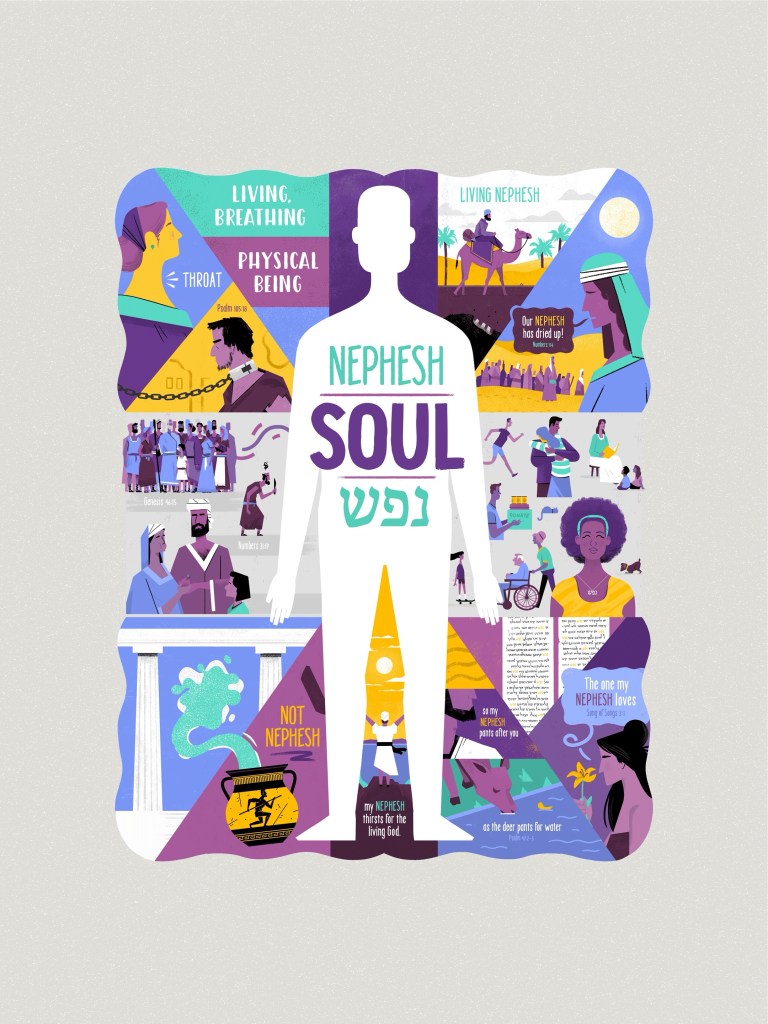
All things that may come in life, all the challenges, the new chapters, it can be easy to lose sight of the eternal. Our souls are often neglected. And that word, soul, is not this separate spirit thing that floats up in the sky after we die. In Hebrew the word is nep̄eš (neh fesh). It’s a powerful word that means your self, life, mind, your very living being. In the Bible it talks about taking care of your soul. The word for keep in Deuteronomy 4 is šāmar (shaw mar) which means to guard it. It also says to do that diligently.
““Only take care, and keep your soul diligently, lest you forget the things that your eyes have seen, and lest they depart from your heart all the days of your life. Make them known to your children and your children’s children—”
Deuteronomy 4:9 ESV
We can’t control the curveballs that life brings. We can’t control how others treat us. We can’t stop the aging process and the new difficulties that it brings. There is so much out of our control. But we can control whether or not we are engaging in life-giving things that help to revive our souls. We can spend time in God’s creation, soaking in the beauty that He made. We can maintain a heart of gratitude, giving thanks for all the little things and the big. We can spend time getting to know our creator through the words He’s given us in the Bible. We can surround ourselves with people who are going to speak truth and love. We can worship, especially when we don’t feel like it. We can keep a heavenly mindset rather than a temporal one. We can use our time to better the lives and world around us. Those things we can control. We can guard our souls and in doing so, we will experience life.
The Bible is full of prescriptions for the believer, to lay down their cares, to surrender their burdens and anxieties. In 1 Peter it says to cast our anxiety on Him because He care for us. Philippians chapter four talks about not being anxious about anything. Not the big things. Not the small things. It’s an invitation to be in communion with Him. To view our God as a loving father who knows what we need especially when we don’t.
I have found though, that it is easier to pray, and to feel the temporary relief that faith and trust brings, than to permanently release those things. That is what I have been working on in my own life. As things add up, problems and stresses compound on one another, it’s even harder to release them all. Yet all the more important. I have been trying to figure out what that looks like. Casting my cares should look far more like tossing a stone into the water rather than a fishing line. I don’t want to real the cares back in. Yet my mind can easily drift in that direction. But how do I give over my burdens while severing the connection? Truth be told, I don’t think that’s the point.
I have been searching for the magical moment of permanent spiritual peace in spite of what stressors I face. What I have found is not something that is passive. Yet I feel it is taught that way often. Pray, release your cares, and go about your day, and it’ll be all good. Never in my entire life has that been the case. And because of that, it can be easy to feel like something is wrong with me. Like my faith is weak. How can I call myself a believer and still deal with stress and feel anxious at times? Am I being convicted or deceived in asking that question?
At moments, and many of them, I can say that I have been in perfect peace. An unshakable sense of calm, reassurance, and gratitude that warms my inner being. And in many of those occasions, life has been really difficult. The difference between those moments and the turbulent times, is one simple things: what my eyes are fixed on. Do you know the story of Jesus walking on the water? Interestingly, my mother in law is actually at the sea today, where that occurred all those years ago. Remember how Jesus called Peter out of the boat? Truth is, you and me can walk on the water even in the heart of a storm, just as Peter did, but only as long as our eyes are fixed on Jesus. The moment Peter turned his attention to the waves, he sank. That has been my experience, every single time. But Jesus didn’t let Peter drown, and He won’t let me drown. And dear reader, He won’t let you drown either.
“You keep him in perfect peace whose mind is stayed on you, because he trusts in you.”
Isaiah 26:3 ESV
Focus on the problem, and you get problems. Focus on Jesus, and you get Jesus. That doesn’t mean you avoid problems. It means you seeks Jesus who provides the solutions. And in the waiting, you keep seeking Jesus. You know what happens? You get more Jesus. He told us once to seek first the kingdom of God and all our needs will be taken care of. We either believe that or we don’t. And the seeking isn’t a morning prayer, a momentary plea for help, a quick devotional, blasting a worship song, but all of those, all day, every day. It is a constant connection. Isaiah says that our mind has to be stayed on Him. The Hebrew word for stayed is sāmaḵ. It pictures a mind that is braced by or supported by something. Much like a building is supported by beams and pillars. Takes those away, and the building collapses. In this case, that support is the Lord Himself. Take your mind off Him, and things start to shake, or sink in the case of Peter.
If you’re battling stress and anxiety, it doesn’t make you a bad person or poor Christian. It just means you’re looking in the wrong direction. Put your eyes back on Jesus, and do what it takes to keep them there. Worship, pray, dance, read, surround yourself with good people and feed your soul with life-giving things. And then, do it all over again.
I have tried to make it a point to begin my day in worship. Even if it’s simply laying on my closet floor at 4am before I head out to work, and saying thank you for so many things. You see, it turns my heart in the right direction. Away from exhaustion. Away from anxious thoughts. Away from the difficulties of life. It helps me to lock on my heavenly target, to appreciate where God has placed me, running towards the upward call of Christ Jesus.
Sing a new song…I came across this saying in my Bible study recently. It happens to be the first mention in Psalm 33, but it certainly isn’t the last. The Psalms are ripe with the saying. Psalms 40:3, 96:1, 98:1, 144:9, 149:1I all have the same basic idea: bring a new song. Not the same old resuscitations. The Hebrew word used here is ḥāḏāš (khaw-dawsh’), and it can mean brand new or fresh.
The psalmists return to this phrase again and again: sing a new song. Why? Because God keeps doing new things. His mercies are new every morning. His grace meets us in fresh ways. His faithfulness shows up in seasons we never expected. A living relationship with a living God produces ongoing praise.
I wonder if my tune is often too repetitive. If I am lazy in my praise. If I am not seeing all the new praiseworthy things He does in my life. Thank you for saving me, for my family, this work, my health, etc…while those things are great and very much worth praise and acknowledgment, God is definitely acting anew each day in my life in ways I don’t see. Because I am focused on other things? I am sure I miss so many. I want to sing Him a new song, each day, for His overwhelming faithfulness in that day.
So I invite you to ask yourself, along with me, What has God done recently that deserves fresh praise? How has He sustained you, forgiven you, guided you, or carried you through? Don’t let yesterday’s gratitude be the end of your worship. God is still at work today.
There is a song called “Surface Pressure” from the movie Encanto. In the scene where the song is introduced, Luisa, the middle sister who is gifted with incredible strength, reveals just how much pressure she feels as a part of, not just the family, but the community as well. So many people rely on her and she carries a lot, both physically and, come to find out, emotionally. I think many of us can find ourselves in a similar situation, minus the carrying of extremely heavy loads like this fictional character does. But we, and I speak about myself in this, try to carry so much when a lot of it, we thrust upon ourselves.
I’ll be honest, there isn’t one area of my life where I can’t easily feel bogged down and drained from constant demands and expectations. Whether at home, teaching, running a business, trying make ends meet, don’t get me wrong, I am a very blessed man with a lot of blessings in my life, especially my wife and kids. Bur it all can get very heavy very quickly. Because of this, it is imperative that I know that I don’t have to carry this alone. I would be crushed, like so many are, if I tried to do all of this alone.
“Cast your burden on the Lord, and he will sustain you; he will never permit the righteous to be moved.”
Psalm 55:22 ESV
We live in a world that constantly reminds us of our limits. Limited time. Limited energy. Limited patience. Limited strength. Some days we feel capable and confident; other days we feel exhausted, overwhelmed, and unsure how to take the next step.
Yet Scripture points us to a different source of strength—one that does not run dry. True strength is not found in self-reliance or sheer determination. It flows from a living relationship with Jesus Christ. When we walk closely with Him, we discover that our strength is no longer dependent on circumstances or personal ability, but on His unchanging power.
Jesus invites us into a relationship, not a formula. He says:
Remain in me, as I also remain in you. No branch can bear fruit by itself; it must remain in the vine.”
John 15:4
When we remain in Him, His life flows through us. Our weakness becomes the place where His strength is revealed.
The apostle Paul understood this paradox well. After pleading with God to remove a persistent hardship, he heard the Lord respond:
My grace is sufficient for you, for my power is made perfect in weakness.
2 Corinthians 12:9
God does not wait for us to be strong before He works. He meets us in our weakness. When we acknowledge our need for Him, we make room for His power to move in ways we could never achieve on our own.
“Humble yourselves, therefore, under the mighty hand of God so that at the proper time he may exalt you, casting all your anxieties on him, because he cares for you.”
1 Peter 5:6-7 ESV
Limitless strength through Jesus does not mean a life free from struggle. It means we are never alone in the struggle. His strength sustains us in parenting, ministry, work, relationships, and seasons of loss or uncertainty.
“All the ways of a man are pure in his own eyes, but the Lord weighs the spirit. Commit your work to the Lord, and your plans will be established.”
Proverbs 16:2-3 ESV
A relationship with Jesus is nurtured through daily connection—prayer, Scripture, worship, and obedience. As we spend time with Him, our perspective shifts. Fear gives way to faith. Anxiety gives way to peace. Weariness gives way to endurance.
I can do all things through Christ who strengthens me.
Philippians 4:13
This is not a promise of unlimited success, but of unlimited strength to face whatever comes with Christ at the center.
When we stop striving to manufacture our own strength and instead lean into our relationship with Jesus, we discover a freedom that transforms how we live. His strength is steady. His grace is sufficient. His presence is constant.
No matter how depleted you feel today, the invitation remains open: come to Jesus, and let His strength become yours.
Come to me, all you who are weary and burdened, and I will give you rest.
Matthew 11:28
In Him, our strength is never truly limited—because it comes from an infinite and limitless source.
Have you ever had one of those ‘lightbulb moments’? You know, when a new realization dawns on you? Like a veil has been lifted from your eyes. Like the lights have been turned on and you can actually see now. Ok, enough analogy. This is what my faith journey has been like for the last several years.
I was raised in a home that considered themselves Christians. We believed in Jesus. We went to church, when something else didn’t conflict with it. We prayed together at family gatherings on occasion. But Jesus was never a way of life, just a small part of it. I don’t fault my parents for this. It was infinitely more than what they had as children. But you could imagine, I would have a lot to learn as I got older. Starting back in 2010, that unveiling process began. Over the next 15 years, I would learn more about Jesus and my faith than I ever thought was possible. If anything, this has given me a desire to learn even more, and also to question what I think I know and have been taught. As a teacher myself, these are two things that I try to instill in my students: love learning and question what you learn.
It is natural for many to want to fit in. There are not a lot of ‘earth-shakers’ who seek to question and challenge the status quo. Comfort and acceptance drive a lot of people. These things can even cause some to turn a blind eye to certain possibilities. The possibility that what they’ve been taught and believed for their entire life is wrong, for example. Other than comfort and acceptance, pride is a major obstacle to change. However, we cannot let comfort, acceptance, and pride, drive a willful ignorance, or even create a hostility towards those who choose to question.
I believe the number one criteria for every believer, is humility. It should drive our approach towards God, His word, and towards those around us. The more we admit we don’t know the more we are able to grow. I didn’t mean to rhyme just then. Over the years I have learned that so much of what I was taught has been determined by culture rather than the Bible itself. Nowhere is that more obvious than in certain celebrations.
Here are some questions to ponder. Why would Christians teach their kids that Santa is real when they know it is a lie? Why would Christians put up trees and give their kids presents to honor the birth of the Savior of the world? Why would Christians dye eggs and celebrate a bunny during a time when we are supposed to honor our Passover Lamb, Jesus? Why would Christians dress their kids up in costumes and celebrate a day that revolves around witches, monsters, and death? Why would Christians welcome these cultural distractions when they ultimately lure our kids’ focus away from Jesus?
As believers, our ultimate goal is to abide in Christ…to love Him and make Him known. Santa, trees, presents, candy, costumes, bunnies, dyed eggs, do the exact opposite. As someone who grew up in that, I promise that these things only put our children at the center of their own lives, not Jesus. Colossians 3 teaches that Jesus is our very life. In John 11 Jesus says He is the resurrection and the life. In Galatians 2, it says that we no longer live but it is Christ who lives in us. In John 15, Jesus says to abide in Him.
The hope of every Christian parent should be that their kids will love Jesus with their whole hearts and make Him the Lord of their lives. The hope of every Christian should be to honor Christ and make Him known. For all of us, that takes a sincere and humble approach to examine our traditions and beliefs.
There are many other things I have had to question, that I have been taught in the church, that aren’t in the Bible. Doctrine often gets elevated above the Bible. Many of these doctrines exist because pride has made people claim that their interpretation, or what they learned in Bible college, or what their denomination adheres to, is superior to all others. Much of that too has been informed by culture. The fact is, the Bible is complex. Much of it is meditation literature. As someone I know often says, “it is worth many long walks and cups of tea to contemplate.” And honestly, I think Christians need a whole lot more humility in their approach to God’s word. If the Bible isn’t clear on something, we need to stop claiming it is. There is no room for pride behind the pulpit or conceit among the congregation. Jesus is the way, the truth, and the life, and that’s how we should be living our lives.
In a world where so much becomes a performance, Jesus wants to redirects our hearts back to what matters: practicing our faith before an audience of One. In Matthew 6, part of what is known as the sermon on the Mount, He teaches that giving, praying, and fasting are meant to be intimate expressions of devotion—not spiritual displays.
When we give, Jesus warns, “Beware of practicing your righteousness before other people in order to be seen by them” (Matthew 6:1). Instead, He reminds us, “When you give to the needy, do not let your left hand know what your right hand is doing… and your Father who sees in secret will reward you” (Matthew 6:3–4). God sees the quiet generosity that others never notice.
When we pray, we’re invited into a private conversation with our Father. Jesus says, “Go into your room and shut the door and pray to your Father who is in secret” (Matthew 6:6). God isn’t impressed with long speeches or public displays; He delights in honest hearts. As 1 Samuel 16:7 reminds us, “The Lord looks on the heart.”
When we fast, Jesus says not to make it obvious or dramatic. “When you fast, do not look gloomy… but anoint your head and wash your face, that your fasting may not be seen by others… and your Father who sees in secret will reward you” (Matthew 6:16–18). Fasting becomes powerful not because others see our sacrifice, but because God sees our dependence.
In all these practices, Jesus draws our focus to the unseen God who watches, listens, and treasures every sincere act of devotion. The world may overlook what we do in secret—but “your Father who sees in secret” never does. And truly, His approval is enough.
With a heavy heart, I opened my Bible. I began in Psalm 108 and went no further. This Psalm is a beautiful declaration of faith, joy, and confidence in God. Exactly where I knew my heart should be. David did not write a half-hearted song; it’s worship that springs from deep trust. Even before his circumstances change, David chooses to lift his eyes and his voice to God.
“My heart is steadfast, O God! I will sing and make melody with all my being! Awake, O harp and lyre! I will awake the dawn! I will give thanks to you, O Lord, among the peoples; I will sing praises to you among the nations. For your steadfast love is great above the heavens; your faithfulness reaches to the clouds. Be exalted, O God, above the heavens! Let your glory be over all the earth!”
Psalm 108:1-5 ESV
A Heart Set Firm on God
A steadfast heart doesn’t waver with emotion or circumstance. It’s anchored in who God is. David’s focus isn’t on his enemies or his problems, but on God’s unchanging love and faithfulness. When we choose praise before victory, we declare our faith that God is already at work.
Awakening the Dawn
David says, “I will awaken the dawn.” I love this! What a picture of active worship! Instead of waiting for joy to come, David brings it by starting his day with praise. His music becomes a sunrise of faith. We, too, can awaken the dawn in our own lives by starting each morning with gratitude, worship, and the Word of God.
Praise That Reaches the Nations
David’s praise is not private—it’s global: “I will praise you, Lord, among the nations.” True worship spills over. When we proclaim God’s goodness, others see His glory. Our steadfast faith becomes a testimony that shines far beyond our own circle. The world is changed when God’s people praise Him, especially in their times of difficulty.
Love Higher Than the Heavens
This section of the psalm ends with awe. God’s love is immeasurable—“higher than the heavens”—and His faithfulness stretches “to the skies.” When we look up, we’re reminded that His promises are vast, enduring, and beyond comprehension.
What does it mean for your heart to be “steadfast” today? How can you “awaken the dawn” through worship and gratitude? In what ways can your praise reflect God’s glory to others?
Lord, make our hearts steadfast in You. When we feel weary or uncertain, remind us that Your love never fails. Let our praise rise like the dawn and fill the world with the sound of Your glory. Be exalted, O God, above the heavens—let Your glory shine over all the earth.
Recently my daughter prayed and asked Jesus to help her to let Him in. Keep in mind, she has already accepted Jesus as her Lord and Savior. But, as all followers of Jesus know, we have to continue to pursue that relationship the rest of our lives. I think this is what her precious 11 year old heart was searching for.
In this post I would like to present a picture of what it looks like to let Jesus in. From the beginning of the relationship to the end.
The Invitation
Here I am! I stand at the door and knock. If anyone hears my voice and opens the door, I will come in and eat with that person, and they with me.
Revelation 3:20
This powerful image shows Jesus as someone who initiates relationship, but waits to be welcomed in. Jesus never forces His way into our lives. Opening the door represents faith, surrender, and a desire for fellowship with Him.
Yet to all who did receive him, to those who believed in his name, he gave the right to become children of God.
John 1:12
Letting Jesus in means receiving Him—not just as a visitor, but as your Savior, King, and the center of your life. Believing in Him opens the door to being born again into God’s family.
If you’re like me, you have probably had to repeat this process more than once. I did at the age of 12, and was baptized. I did again at the age of 27 when my faith became of central importance. I have also had many moments since when I am disconnected and I hear Him knocking again. These aren’t salvation moments, I know I am saved and redeemed. These are sanctifying moments. Those reminders that I am not where I am meant to be in my headspace and heart. Those subtle, and sometimes not so subtle redirecting moments.
The Process
I will give you a new heart and put a new spirit in you…
Ezekiel 36:26
When Jesus enters your life, He doesn’t just visit—He renovates. He gives a new heart, replacing coldness or stubbornness with a heart that wants to obey and love Him.
To have found God and still to pursue Him is the soul’s paradox of love.
AW Tozer
Walking with Jesus means both finding and continually seeking Him—never settling for a distant relationship. Always wanting more. Always going deeper.
And we all, with unveiled face, beholding the glory of the Lord, are being transformed into the same image from one degree of glory to another. For this comes from the Lord who is the Spirit.
2 Corinthians 3:18
I think we can all agree that the Christian walk should be a progressive one in the sense that we are moving forward and upward and deeper. And it should also be transformative in the sense that we are more like Jesus in attitude, action, speech, and motivations the longer we know Him. Not to say that we won’t make mistakes or have our “moments”. But it should be a general upward and life altering change throughout life.
Nearness to God brings likeness to God. The more you see God, the more of God will be seen in you.
Charles Spurgeon
Every day should be a commitment to reflect on whether this is true in us.
The Commitment
I have been crucified with Christ and I no longer live, but Christ lives in me…
Galatians 2:20
Letting Jesus in is more than a one-time moment. It means allowing Him to live in you, shape your thoughts, and guide your actions. His presence becomes your source of strength and purpose. Letting Jesus in means surrendering to His Lordship (rulership, authority which overrides our own.) in Medieval times Lords controlled the land, your life, your freedom, your movement, your purpose. They also provided everything their vassals needed in food, land, and protection. Those were imperfect people and an imperfect system. But the analogy works in many ways. Our Lord is not a despot. His heart is for the flourishing of His people. Far too often, I afraid, we treat Jesus as a guest to be entertained or invited in when we need Him. But He is owed so much more.
For by him all things were created, in heaven and on earth, visible and invisible, whether thrones or dominions or rulers or authorities—all things were created through him and for him. And he is before all things, and in him all things hold together.
Colossians 1:16-17
Jesus deserves to be the captain of your ship because He built the ship, maintains the ship, and owns the ship.
Discipleship is the process of becoming who Jesus would be if he were you.
Dallas Willard
A true walk with Jesus transforms your character to reflect Him in your unique life and context. Remember, our mission is to help bring His kingdom wherever we are and wherever we go. I tell my kids (and have to remind myself) all of the time that our sole purpose is to love God and make Him known. What better way to do that than to allow Him to steer our very motivations for life, love, purpose, relationship, and more?
Remain in me, as I also remain in you.
John 15:4
Letting Jesus in is ongoing. It’s not just a decision, but a relationship of remaining close to Him, hearing His voice, and living connected to His love every day. Abiding With Jesus is a Lifelong Commitment.
Letting Jesus in is ongoing. It’s not just a decision, but a relationship of remaining close to Him, hearing His voice, and living connected to His love every day. Abiding With Jesus is a Lifelong Commitment.
Francis Chan
There are very real pitfalls. Those of apathy…of distraction…misalignment…misjudgments…and the like. To let Jesus in is something we have to contend for, hold on to, and adamantly desire. The Christian life is just that, a lifelong lifestyle.
The Christian does not think God will love us because we are good, but that God will make us good because He loves us.
CS Lewis
It is imperative to remember that walking with Jesus is not about earning love but being changed by it. There is so much grace and so much love in the pursuit.
In a world full of noise, opinions, and ever-changing values, the Christian gospel stands as a clear and unwavering beacon of truth. Its message is simple, yet profound: salvation by grace alone, through faith alone, in Christ alone. The purity of the gospel is not something we invent or evolve—it is something we receive, guard, and proclaim.
I realize some who read this may not know exactly what the gospel is. At its core, the gospel is the good news that God, in His love and mercy, took on human form in the person of Jesus (Colossian 2:9), walked among us (John 1:14), lived a perfect life knowing that no person ever could (2 Corinthians 5:21), allowed humanity to hang Him on a cross to be a sacrifice for our sins (Romans 5:8), was buried and rose from the dead three days later (1 Corinthians 15:3-4), giving us the hope of new life and a future resurrection. This message is not about human achievement or moral performance. It’s about divine intervention—God doing for us what we could never do for ourselves. It is unearned, undeserved, and freely given.
The gospel is pure, and holy, and beautiful. And that is why everyone needs to hear it. It does, however, pact a punch. The gospel requires we take a hard and accurate view of ourselves, our needs, our shortcomings, our brokenness, and our sin. Only then can we see the beauty that is the gospel.
When we dilute or modify the gospel—adding works, subtracting grace, changing who Jesus is, softening the reality of sin, or removing the need for repentance—we rob it of its saving power. A compromised gospel may feel more comfortable or inclusive to some, but it cannot save anyone. We have to fight the desires for what is “good in our own eyes” and embrace what is actually good for us. Humility. Embracing grace. Accepting God’s love. Allowing Him to transform us more and more into His own likeness. That is when we become the best version of ourselves. That is when we experience the deepest joys and peace that every soul searches for.
The gospel’s purity is what makes it powerful. It tells the hard truth about sin but offers the glorious truth about redemption. It doesn’t offer self-help; it offers a new self in Christ.
Many voices today claim to speak for God. Some offer “prosperity,” “comfort,” or “love is love” as gospel substitutes, but these fall short of the cross. The true gospel does not promise comfort or success; it promises forgiveness, transformation, and eternal life through Jesus.
Jesus said, “I am the way, the truth, and the life. No one comes to the Father except through me” (John 14:6). That statement is both exclusive and inclusive—exclusive in that Jesus is the only way, but inclusive in that He invites all who will believe.
As followers of Jesus, we are called to preserve the purity of the gospel message, not tamper with it. Jude writes, “Contend for the faith that was once for all delivered to the saints” (Jude 1:3). The gospel is not ours to edit—it is God’s truth to trust, live out, and share. May we never lose sight of the beautiful simplicity and power of the gospel. In Christ alone, by grace alone, through faith alone—that is our eternal hope. And it can be yours too.
“He is the image of the invisible God, the firstborn of all creation. For by him all things were created, in heaven and on earth, visible and invisible, whether thrones or dominions or rulers or authorities—all things were created through him and for him. And he is before all things, and in him all things hold together. And he is the head of the body, the church. He is the beginning, the firstborn from the dead, that in everything he might be preeminent. For in him all the fullness of God was pleased to dwell, and through him to reconcile to himself all things, whether on earth or in heaven, making peace by the blood of his cross.”
I don’t know about you all but I feel like I am always in preparation mode. As a parent, spouse, teacher, business owner, you name it, I am preparing and planning. Preparing to start the day, throughout the day, and in ending the day. It is an integral part of every single day of my life.
When I was an athlete, I had to train. Conditioning, technique, and strength training were all essential. My diet had to be fine tuned, I watched tape to see what I could fix, and would go to camps and tournaments out of season so I could be successful. As a teacher, I have to prepare lessons, gather materials, assess learning, reflect on student performance, plan and replan to make sure the students receive a quality education. But there is another role, the most essential role of my life, that I need to prepare for even more.
For we are his workmanship, created in Christ Jesus for good works, which God prepared beforehand, that we should walk in them.
Ephesians 2:10
Teaching and sports are great things, but they aren’t THE thing. We are God’s workmanship, His children, His image-bearers. Just as we prepare for tasks in our daily lives, God calls us to be ready for every good work He sets before us..that He’s already prepared for us.
“Do you not know that in a race all the runners run, but only one receives the prize? So run that you may obtain it. Every athlete exercises self-control in all things. They do it to receive a perishable wreath, but we an imperishable. So I do not run aimlessly; I do not box as one beating the air. But I discipline my body and keep it under control, lest after preaching to others I myself should be disqualified.”
1 Corinthians 9:24-27 ESV
We keep our eyes on the prize (knowing Jesus and making Him known) and we don’t go about it aimlessly. Our spiritual life should reflect the intentionality and dedication that athletes at the highest level would dedicate to their trade. Let’s take a look at the training regiment.
All Scripture is breathed out by God and profitable for teaching, for reproof, for correction, and for training in righteousness, that the man of God may be complete, equipped for every good work.
2 Timothy 3:16-17
1. The Source of Our Equipping: God’s Word
“All Scripture is breathed out by God”
Scripture is inspired by God, making it divine in origin and purpose. It is trustworthy, authoritative, and sufficient for our spiritual growth. The Bible is the most factually based book in world history. No other book in history claiming to be God’s word even comes close to matching these facts.
1. Written by 40 men over a period of 1500 years and ALL subjects, prophecies, and evidence agrees.
2. It was written in three very different languages by people who lived on three different continents.
3. The authors of the Bible lived in very different time periods, very different places, and had different occupations but ALL focused on God’s redemption of mankind.
4. Over 300 prophecies were about Jesus, made hundreds of years before he was born, and He fulfilled ALL of them exactly how they said it would happen. The odds of a single person fulfilling just eight messianic prophecies are estimated to be one in 100 quadrillion.
5. Hundreds of other non-messianic prophecies have been made and fulfilled just as the bible said. They were fulfilled exactly to the day and exactly how they were predicted and they occurred sometimes hundreds of years after they were made.
Just as a carpenter relies on tools for precision, we rely on God’s Word to shape our worldview, guide us in decision making, and know how to be in relationship with God and others. Spend time in the Word daily—it’s not optional but essential for being equipped. We should be meditating on it, memorizing it, praying through it, and speaking.
2. The Purpose of God’s Word: To Shape Us
“Profitable for teaching, reproof, correction, and training in righteousness”
Teaching: Helps us understand who God is, who we are, and His will for us.
Reproof and Correction: Reproof means to convicts us of sin and then provides the correction that redirects us to the right path. It is a mirror into the soul. Like Psalm 119:105 says, “Your word is a lamp to my feet and a light to my path.”
Training in Righteousness: Helps us grow in godly character and holiness. So much of the world gets their ideas of righteousness, or right living, from the culture or their own emotions. Even a lot of believers who interpret God’s will through their own emotions. That’s a pitfall from a lack of wisdom that can only come through knowing God’s word.
A sculptor chisels away excess stone to reveal a masterpiece. In the same way, God’s Word refines us. The more we know God’s word the more we should be changed by it. Let the Word challenge and transform you. Like Jesus said, “Not everyone who says to me, ‘Lord, Lord,’ will enter the kingdom of heaven, but the one who does the will of my Father who is in heaven.” Don’t just read it—let it read you.
3. The Result of Being Shaped by God’s Word: Readiness for Good Works
“That the man of God may be complete, equipped for every good work.” (the greek word is anthropos which means human or person of God, not man specifically)
God doesn’t just call us to good works; He equips us for them through His Word. The good works we are called to include acts of service, evangelism, generosity, and godly living. The Bible doesn’t just tell us to talk about God but do so boldly, not just to love but to love sacrificially, not just to give but to give generously and without asking for anything in return, not just to serve but to do so selflessly never drawing attention to yourself. It helps us endure hardships, be patient in trying times, hopeful in our outlook, and joyful in our spirit. To be a light, a city set on a hill.
Look for opportunities in your daily life to do good. Be ready when God opens a door. Better yet, look for the open doors, seek out the opportunities, don’t just wait for a clear “sign”. Training narrows our focus. It removes distractions that can derail us from achieving our goal. That’s exactly how we need to approach the mission God has for all of our lives. We clutter our vision (and we do so willingly if we’re honest). Remember Ephesians 2:10, God has already prepared our good works. You ever wonder how many we miss?
4. The Call to Action: Commit to Being Equipped
So where does this leave us? Just like with sports, careers, parenting, or anything else that requires training and preparation, we are all at different stages in our faith journey. But we can, and should, evaluate our time and how it’s spent. To what extent are we being intentional in applying God’s Word to situations in life? Do we pray for readiness and sensitivity to God’s leading. Do we actively look for ways to love, serve, give, and share the gospel every day. Wherever you are in your faith journey, I invite you to train harder. We can all pray more, serve more, love more, give more, empathize more, share the gospel more, meditate on God’s word more, worship more. Not to earn anything, that price has already been paid, but to better live out what you were designed and created to be…an image-bearer. The light that shines from us will only be as bright as the light we allow in us. You were made for a purpose and God has an abundant life planned for you. We just have to choose it.















 For Common Ground