It is one of the most amazing and beautiful things in a person‘s journey of faith, when in the moments of need, God reveals himself in unexpected ways. When we are hurting, or getting wrapped up in the ups and downs of life, there he is in a chance meeting with perfect strangers. I can honestly say that I have had this experience quite a few times in my 44 years of life. I had one of those such experiences today. I was caught up in the difficulties of life, and God brought me the reminders I needed. I was driving home after a long day of work felt this sudden urge to pull over at an overlook that I’ve been to many times before. I was exhausted and just wanted to get home, but this urging to stop couldn’t be ignored. I have learned through my experiences to not ignore these urges. There I ran into an older couple and asked if they wanted me to take their picture for them, and immediately after the husband started speaking life and scripture and Jesus came pouring forth. You may or may not have heard the term divine appointment before, but this certainly felt like one of those God ordained moments. The conversation was brief, only a couple of minutes. But I felt God lovingly, reminding me of his love, of his presence, and of his caring nature.
Believe me, ladies and gentlemen, he cares about every detail of your life. No matter where you are in your journey of faith, look for him in the unexpected. Don’t ignore what could be the urging of the Holy Spirit. See Kim first and see Kim always because he loves you more than you can ever know. Peace in Christ brothers and sisters
This year has been full of challenges. In fact, 2026 has been one of the hardest in recent memory. But I feel the hardest times can become the most fruitful times. First Peter 1:6-7 says “In this you rejoice, though now for a little while, if necessary, you have been grieved by various trials, so that the tested genuineness of your faith—more precious than gold that perishes though it is tested by fire—may be found to result in praise and glory and honor at the revelation of Jesus Christ.”
It’s in those refining periods of life that God remakes the person. Often, our difficulties show us so much of what is broken inside of us. Broken perceptions, broken motives, broken view of self, remnants of the life before Christ that need to be dealt with, lies you’ve believed even since becoming a believer…God is pointing us to areas that need to be healed rather than circumstances that need to be changed. And the thing is, sometimes it takes hardship to make us fully aware of this junk in the first place. In those times we usually gravitate towards, Jesus please fix this, when maybe we need to be saying Jesus please fix me through this.
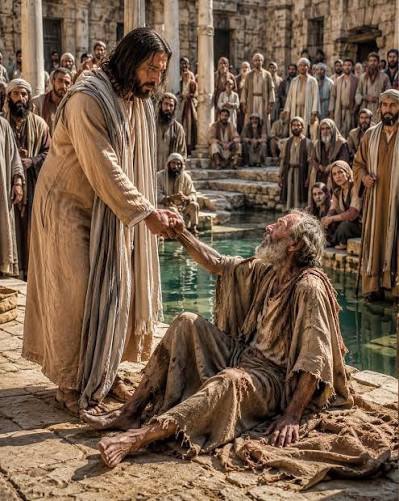
“After this there was a feast of the Jews, and Jesus went up to Jerusalem. Now there is in Jerusalem by the Sheep Gate a pool, in Aramaic called Bethesda, which has five roofed colonnades. In these lay a multitude of invalids—blind, lame, and paralyzed. One man was there who had been an invalid for thirty-eight years. When Jesus saw him lying there and knew that he had already been there a long time, he said to him, “Do you want to be healed?” The sick man answered him, “Sir, I have no one to put me into the pool when the water is stirred up, and while I am going another steps down before me.” Jesus said to him, “Get up, take up your bed, and walk.” And at once the man was healed, and he took up his bed and walked. Now that day was the Sabbath.” John 5:1-3, 5-9 ESV
And by this point in the story, Jesus had already started shaking things up. He had cleansed the temple by driving people out with a whip. He had turned water into wine at the wedding in Cana. He had his intimate conversation with Nicodemus, a high ranking and respected Jewish leader and member of the Sanhedrin. He also announced himself publicly to the woman at the well and healed the officials son. But what Jesus does in our passage today puts the crosshairs on Him like nothing before. Because what Jesus is about to do is exactly what the Gospel is all about. This is God’s mission among His creation.
Jesus asked a lot of questions during his ministry. Scholars have counted over 300. Questions like “Who do you say that I am?” or “Why are you afraid, ye of little faith?” or one I hear quite often, “Why do you worry?” But the questions here can be a head scratcher. To us readers today, it seems like a rhetorical question. Jesus asks, “Do you want to be healed? “ He’s been an invalid for nearly 4 decades, Jesus, of course, he wants to be made well.
Depending on your translation, you will see a different word there. The ESV uses healed, the NIV uses well, and the NKJV uses the word whole. The Greek word used is hugios (hoog-ee-ace), which means to be restored to wholeness or soundness. So this begs the question, was Jesus just asking about physical healing? Or was Jesus challenging the man to consider if he was truly ready to embrace a larger transformation?
Before Jesus asked the man the question, the verse began with “When Jesus saw him lying there…” Let’s start from this standpoint: Jesus sees our conditions completely.
Others saw a crowd. Jesus saw a man. Others may have passed by this suffering man every day without noticing him. But Jesus stopped. The beautiful truth of the gospel is this: Jesus sees us personally. He sees: the pain nobody else understands, the private struggles, the hidden wounds, the disappointments we carry silently. Not only did Jesus see the man — He “knew that he already had been in that condition a long time.” Jesus knew his history. He knew the years of frustration. The unanswered prayers. The isolation. The emotional exhaustion. And still, Jesus came near.
Now, let’s think about the condition of the man. This man had suffered for thirty-eight years. Long suffering can create deep hopelessness. That kind of prolonged struggle changes a person. Long-term pain can slowly produce resignation. After enough disappointment, people stop expecting change. Perhaps this man no longer believed healing was possible. Perhaps he had adjusted his identity around his condition. And many people do the same spiritually.
Some become comfortable in their bitterness, addiction, fear, anger, unhealthy habits, or spiritual apathy. Not because they enjoy bondage, but because they have lived with it so long that freedom feels impossible, unfamiliar, and even scary. But Jesus specializes in entering hopeless situations. No situation is too old. No heart is too hard. No life is too broken. The length of the struggle does not limit the power of God.
And now to our question. “Do you want to be healed, made well, or whole?” This question exposes something important: healing requires honesty. The man could have simply answered “yes,” but instead he began explaining why he had not been healed: “Sir, I have no one to put me into the pool…” Jesus asked about desire. The man answered with excuses.
And how often do we do the same?
God asks: “Do you want freedom?” “Do you want reconciliation?” “Do you want spiritual renewal?”
And we respond: “But you don’t understand my situation…” “Nobody has helped me…” “I’ve tried before…” “It’s too hard…”
Excuses can become shelters for unwillingness. The truth is, we often want relief from consequences more than transformation of character. Jesus’ question forces us to examine whether we truly desire change or merely desire comfort.
Real healing will require surrender. To be healed would mean this man’s life would completely change. No more lying by the pool. No more dependence on others. No more identity built around being disabled. Sometimes people resist healing because healing requires change. Jesus never forces transformation upon anyone. He invites us to respond. And that’s because the gospel is not merely about making life easier — it is about making us new.
The man believed the pool was the answer. But the true answer was standing in front of him. Jesus is the Source of true wholeness. So often we search for healing in: success, relationships, money, distractions, self-help, or human approval. And those are no different than lying by a pool for 38 years. No earthly thing can heal the soul. Only Christ can restore what sin, pain, and brokenness have damaged.
Jesus did not merely offer the man improvement. He offered wholeness. That is why several verses later, when Jesus sees him again, He reminds him to walk in the newness of life that Jesus gave him. And He does the same for you and me. Giving us not temporary relief —but new life.
Peace, and healing, in Christ brothers and sisters.